The Brief
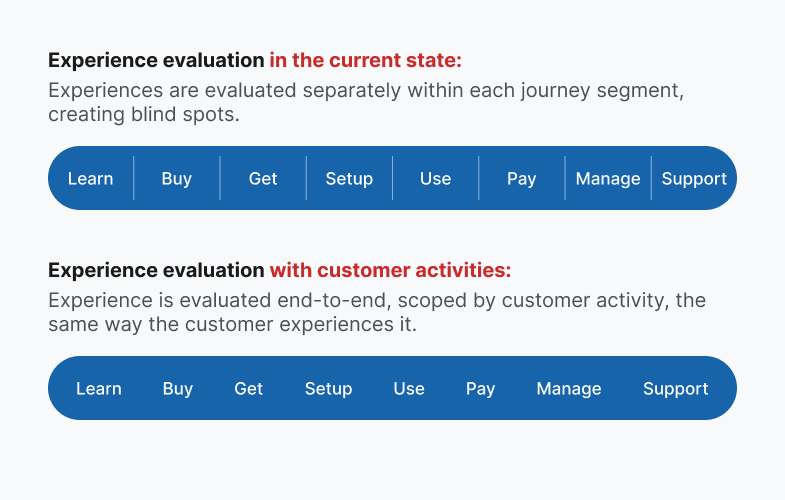
Verizon product teams have traditionally evaluated experiences through the lens of business-goal-oriented initiatives, working to address opportunities and pain points in isolated and highly matrixed segments (e.g., “phone upgrade - digital” and “phone upgrade - retail” are separate teams). Inconsistent ways of evaluating experience across teams were leading to gaps in the customer’s experience with the company and its products due to a lack of cross-team visibility and communication.
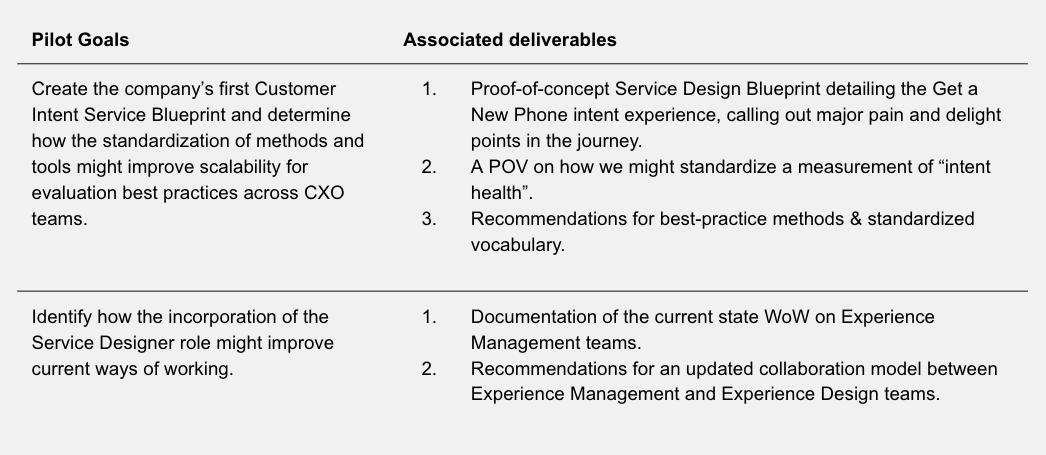
As the first member of the Strategic Initiatives team, I was tasked with running a pilot to explore the potential opportunities in shifting from an initiative-driven model to a “customer-intent-driven” model, creating a proof-of-concept service design blueprint and recommending updates to established “ways of working” to help enable a shift to customer-intent-based workflows.
Our Hypothesis
Customers judge their experience of fulfilling an intent with Verizon based on their perception of the holistic journey. If we don’t view experiences the way customers do - as a single, continuous goal - we cannot truly measure if those experiences are successful.
Building intent-based service design blueprints that reflect the customer’s true end-to-end experience across channels and journey silos will provide working teams with the critical knowledge, context, and insights they lack today, enabling them to collaborate more efficiently and produce more cohesive experiences for end users.
Project Logistics
Role: Lead Experience Designer/Service Designer
Timeline: Oct. 2024 - Jan. 2025
Working Team: myself, a Senior III designer, and a CX Experience Manager
Steering Committee:
Strategy: SVP of CX, Director of CX Strategy, Senior Director of CX Insights
User Experience: VP of UX, Senior Director of UX
Experience Management: AVP of XM, Senior Director of XM
Skills Required: service design blueprinting, customer journey mapping, systems thinking, analysis, collaboration, executive storytelling.
Tools Used: Lucidchart, FigJam, Figma.
Team leadership had previously curated a list of ~70 unique “customer intents” based on deep analysis of existing research. Given the topic's meatiness and our top-priority business goals, we were assigned to run the pilot focused on the “Get a New Phone” intent.
Clarifying the Ask
The initial ask was high-level and ambiguous. We documented a set of guiding questions and worked with project leadership to align on an official project charter.
Clearer boundaries helped the team to…
Create a plan for answering open questions about user flows, user behaviors, user sentiments, and business processes.
Draft an accurate project calendar with key milestones (e.g., steering committee deadlines).
Map the stakeholders and SME’s we’d need to consult.
Communicate our learning goals to partners more clearly.
Q: Who are the primary actors?
A: Existing account owners who are upgrading their phone.
Q: Which channels will be represented?
A: Omnichannel - digital, retail, assisted (ACSS, OMNI, etc.)
Q: Who will be the primary users of the service blueprints?
A: For the short term, the primary audience will be the touchpoint design teams.
Q: Which use cases are included?
A: Upgrading a mobile device
Q: Which use cases are excluded?
A: Adding a line, replacing a broken phone, switching phone companies, and changing phone plans alone.
Q: When does this intent start and end?
A: From the moment a customer discovers the need for a new phone to the moment they enter steady-state monthly billing.
Our Approach
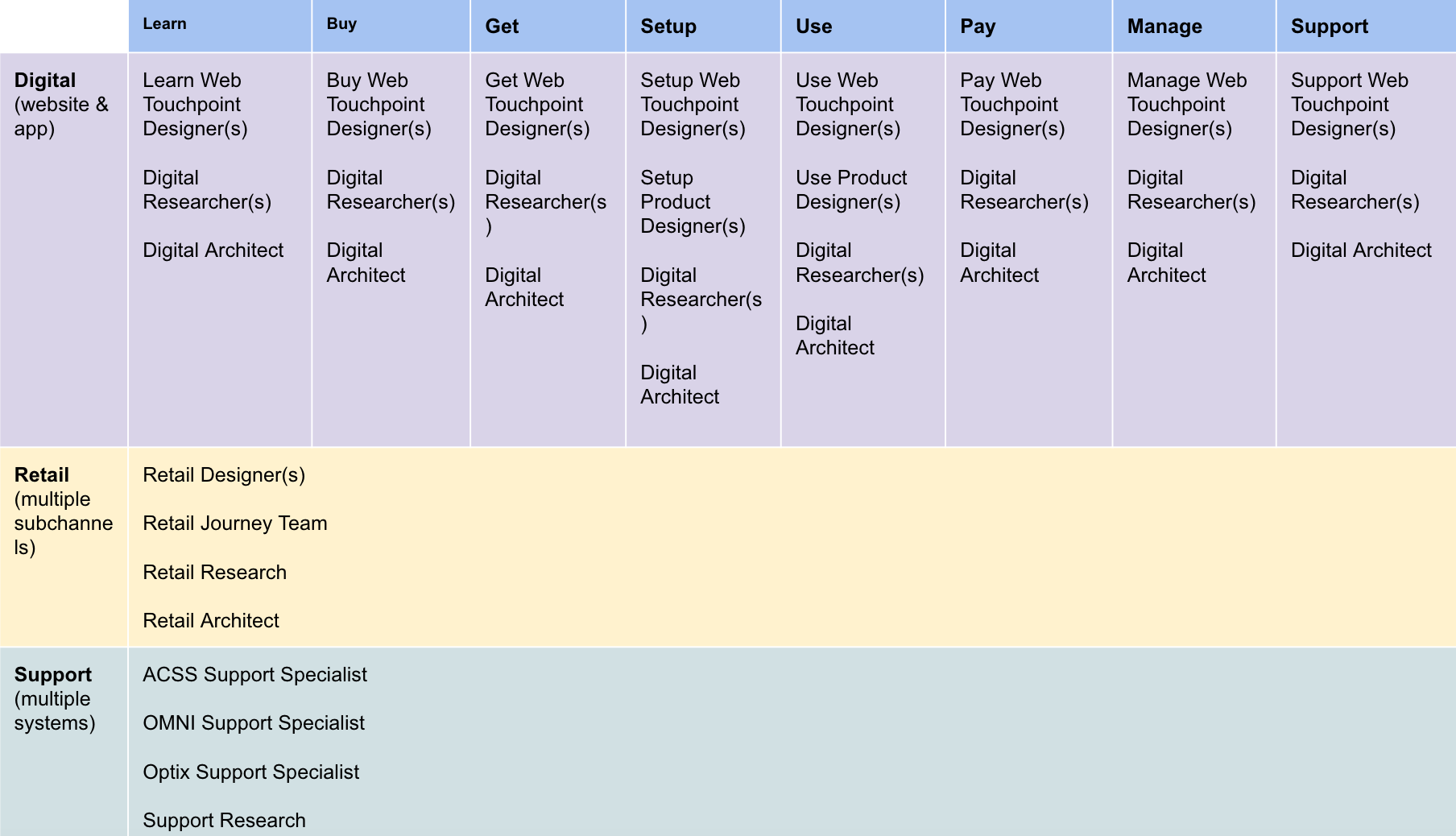
Creating a stakeholder & SME map was a complex task due to the highly matrixed organization. We estimated there were 50+ individuals across 10+ functional teams we might need to consult to visualize the end-to-end experience and its supporting systems.
We were looking at a lot of manual work, asking individuals with limited bandwidth to provide us with documents, time, and energy. To help partner teams quickly get acquainted with our ask and build trust, I created a short project introduction deck that we would share at the beginning of each engagement.
With the understanding that jumping straight into contextual interviews with SME’s would not be an efficient use of time, the team decided on a multi-prong approach to build our service blueprint iteratively.
Step 1: Collect existing generative and evaluative feedback from primary research studies.
Step 2: Consult secondary sources to learn about customer experience and sentiment.
Step 3: Ask touchpoint designers to share the most up-to-date design artifacts of each lifecycle phase (high-fidelity Figma designs, journey maps, user flows, etc).
Step 4: Build a “planning matrix”, or messy working draft of what we believe the end-to-end experience looks like.
Step 5: Validate the high-level journey with additional SME input and user research.
During the pilot, we manually analyzed 13 formal research studies and ~30 different Figma files.
Making the Proof-of-Concept Blueprint
Iterative Experience Mapping
Learning about the user flows in each channel, we saw that the customer would have to take different actions based on the channel (e.g., retail customers wouldn’t be offered the option to add a perk to their order because the rep would be focused on closing the sale, whereas a customer shopping in digital would have to take the time to decide to explore perks or skip the perks offer page altogether).
We also noticed that some phases of a flow could be optional (e.g., customers could skip the optional phase of trading in their old phone for credit).
But our goal was for the blueprint to tell a single story of what the common customer actually looks like - which channels they prefer, when they change channels, where they get stuck, etc. We weren’t able to access behavioral analytics during the pilot, so I documented my perspective on the benefits of data integration in future maps and escalated my idea to leadership.
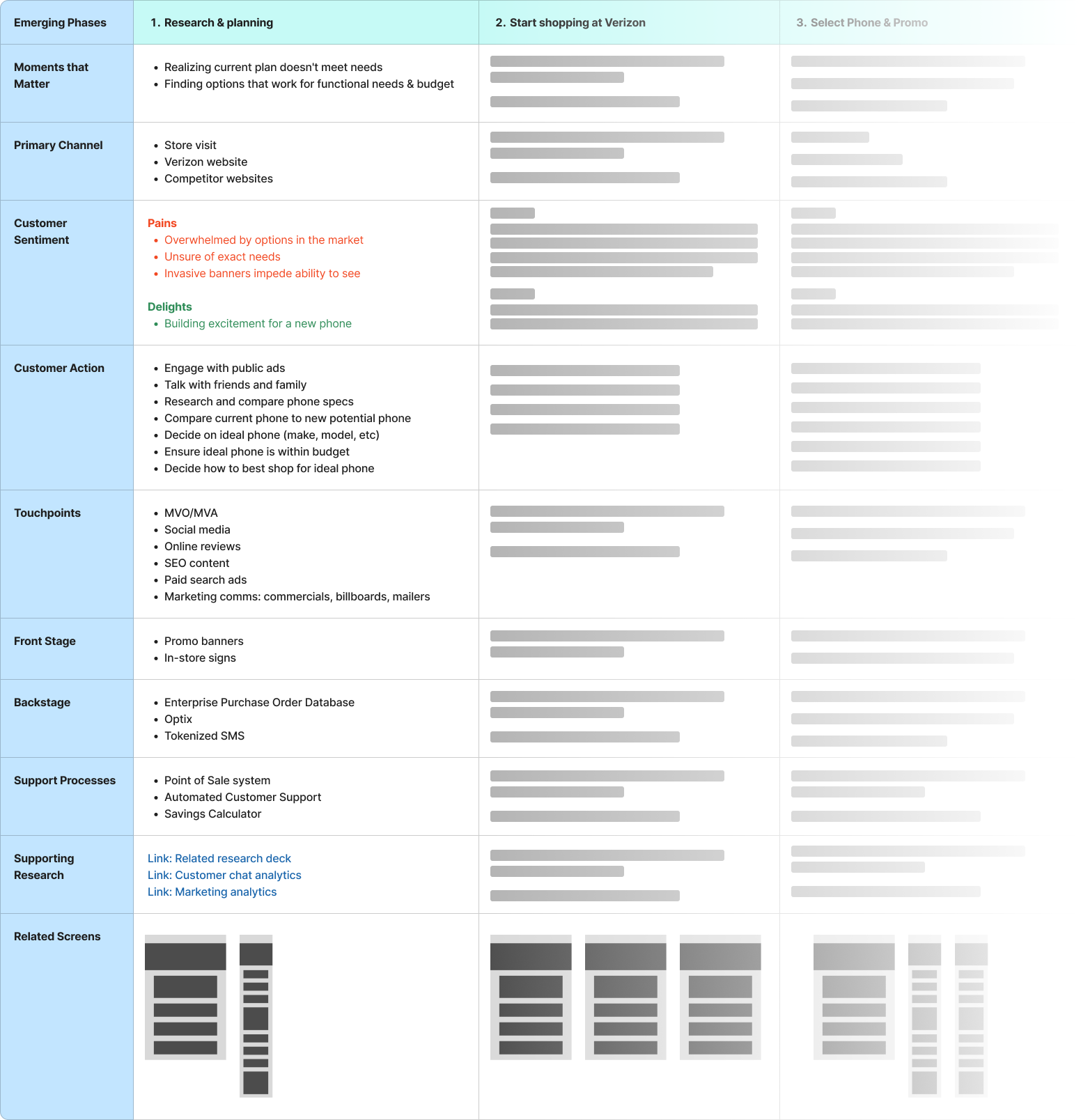
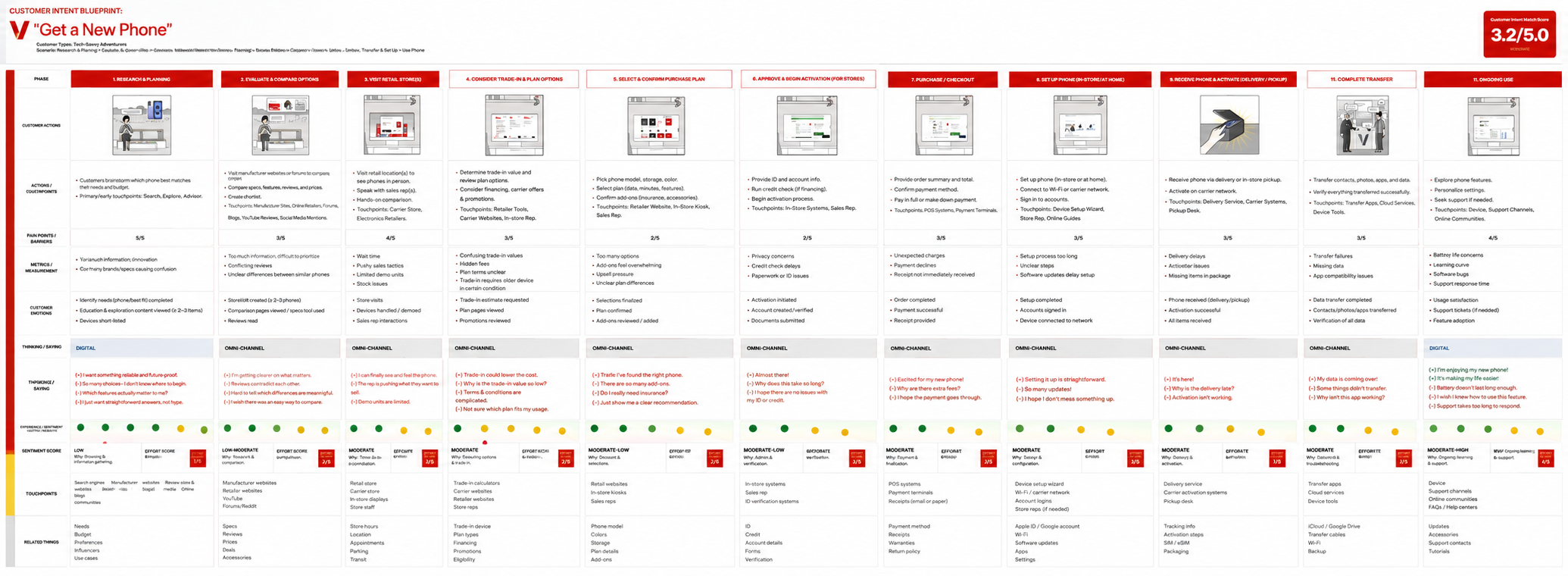
To work around this gap, I manually listed the customer actions that could occur in each channel, then analyzed the similarities and differences of each flow. I created a few iterations of possible structure for review with the wider team, and we aligned on a single streamlined narrative of 11 primary phases.
Because intent-based service blueprinting was an entirely new way of documenting and visualizing experience, the working team met often to share information, align on perspective, and iterate our artifacts as we learned from our early experimentation.
Validating with Internal and External Feedback
To continue validating and refining our draft blueprint, we consulted stakeholders and SME’s from each phase area.
While conducting internal interviews, I also worked with our customer research partners to plan and execute a lean exploratory study to collect direct customer feedback for our map. We were able to execute research and get a readout from the research lead in a 2-week turnaround.
The outputs of this activity provided us with…
Insight into how the customer defines what their “end-to-end” looks like
Phase labels and sentiment quotes in the customer’s own words
Prioritization of the most painful and most delightful areas of experience within the broader E2E context
Previously missing information about what happens in the “cracks” between our silos
We incorporated the new internal and external insights into the blueprint and continued building the story with assurance that the artifact was truly customer-centered.
Measuring the E2E Experience
A key part of our deliverables was to explore how quantifications of experience quality at the “intent-level” might help working teams understand the big picture quickly. As the blueprint evolved, we began working closely with our partners in Customer Insights and CX Strategy, who were responsible for gathering and analyzing behavioral analytics through a business lens. They would help us understand how we might measure “customer intent health” - or how well Verizon is enabling the fulfillment of an intent. Having a “prototype” blueprint gave us a realistic, tangible anchor for these discussions.
The Customer Insights team was working on a concurrent project to develop a modular metrics ecosystem, so we needed to consider how Customer Intent Health metrics might fit into the bigger picture - understanding where data comes from, how it’s used & shared between systems, how it might be interpreted by different teams, etc.
This was a particularly high-complexity aspect of the project. UX acted as a thought partner on the strategic vision.
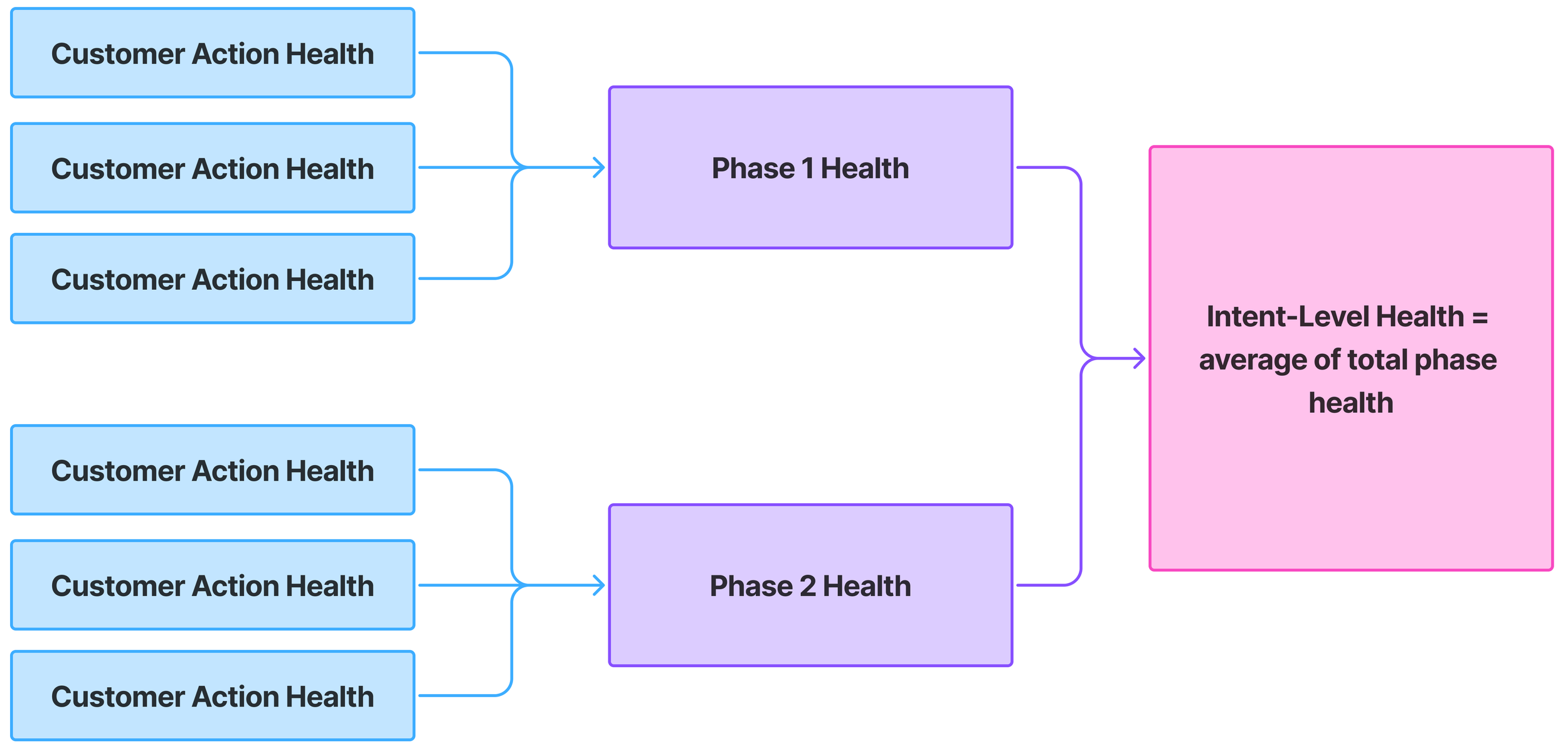
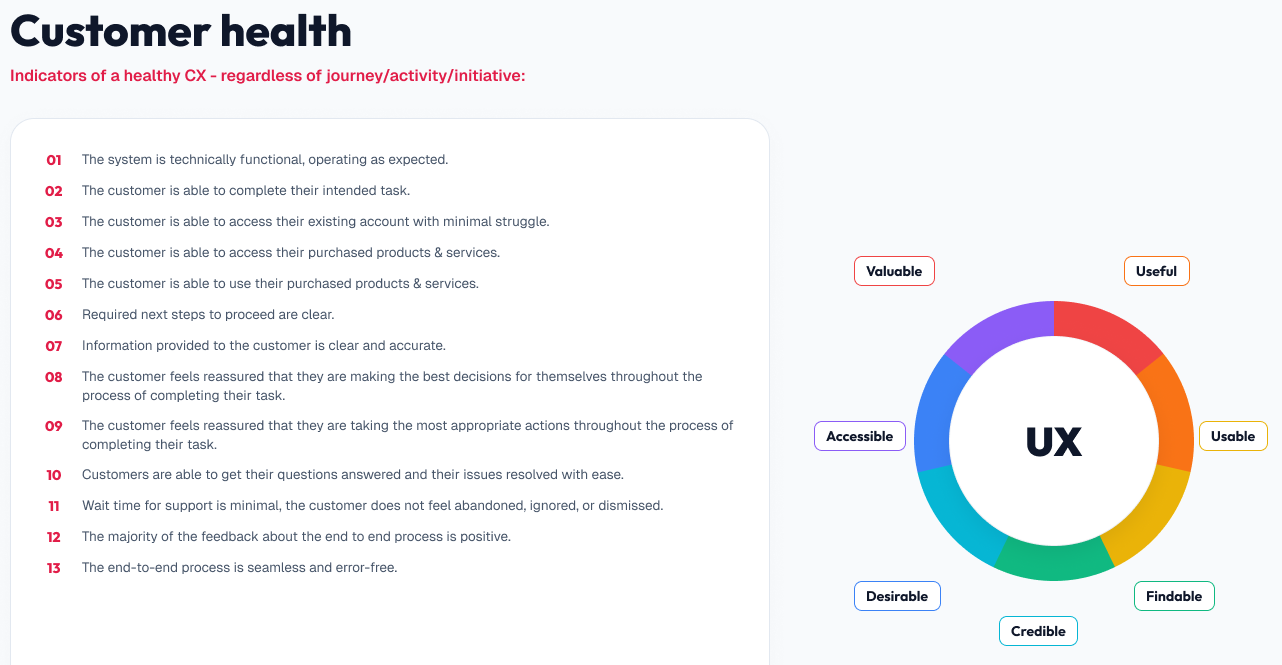
Ultimately, the metrics ecosystem work was a much longer-term initiative that would require significantly more time and resources to think through. The Customer Insights team was hesitant to start building and testing real-time Customer Intents Health metrics until their team could get a better idea of the bigger picture.
While this collaboration established some great foundational thinking on the subject, the blueprinting team needed to continue moving forward with a proof-of-concept blueprint with experience health evaluation metrics to help leadership understand our intended direction.
In preparing to present our work to leadership, I updated our blueprint template to include rows dedicated to phase health and used dummy data to indicate how an overall health score could theoretically be presented.
Final Milestone: Steering Committee Review
The team prepared to wrap up the pilot, working together to create an executive readout of our learnings, insights, and deliverables.

What happened after the pilot?
Knowing that the blueprint was a living artifact that would become dated quickly without consistent upkeep and that our original idea might not scale, the team decided to focus on creating a few more intent blueprints so that we could refine and standardize our process and artifacts.
Steering Committee leadership used a large-scale printer to make physical copies of the first few blueprints to tape up around the offices, asking various people in the Basking Ridge and New York offices to weigh in on the presentation of the customer intent idea.
We used the Get a New Phone blueprint to workshop discovery and ideation phases with 10+ product teams, learning how product teams would actually use these kinds of artifacts in real-time and documenting insights on an ongoing basis.
Since this pilot wrapped, great progress has been made. Multiple reorgs ultimately dissolved the founding Customer Intents team structure, though the Customer Intents framework continues to be leveraged in company-wide initiatives since.