The Brief
Elsevier tried out an experimental process by which innovative concepts were defined, ideated upon, and validated quickly with lean UX. Teams called “Agents of Innovation and Monetization” (AIM) were spun up to support individual ideas/concepts that were pitched by leaders, vetted by the business, and selected for exploration. I was invited to join 2 different AIM teams, serving as the UX Design Lead on each.
Note: Due to the proprietary nature of AIM projects, I cannot provide specific details about or images of the work that was done.
However, I can speak to my responsibilities and the high-level processes I used.
Timeline: 3 months to define the concept, ideate on solutions, test concepts, and make a recommendation
Team: project sponsor(s), UX leads (representing strategy, design, and research), product owner, tech lead, subject matter experts (SMEs) from various disciplines
Skills: workshop facilitation, concept UX/UI design, concept testing, strategy, research analysis, stakeholder management, presenting, organization, cross-functional communication, decision-making
Output: a data-backed recommendation for bringing a minimum-viable, minimum-loveable product to market based on the original innovation idea
My Responsibilities on AIM Projects
As the UX Design Lead assigned to AIM projects, I was responsible for…
Partnering with project sponsors, product owners, and other UX leads to define project deliverables.
Collaborating with key stakeholders and SMEs to define problems and ideate solution concepts.
Designing & leading brainstorming sessions to encourage diverse thinking.
Building user-centered wireframes and interactive prototypes for evaluation by users and buyers.
Assisting with research planning, execution, analysis, and synthesis.
Leading the assessment of desirability, feasibility, and viability of proposed solutions.
Socializing design decisions and research insights to inform and align stakeholders and project sponsors.
Shaping the recommended MVP for market entry, calling out essential versus nice-to-have features.
Providing feedback on the process to ensure future AIM teams are well-supported.
The High-Level Process
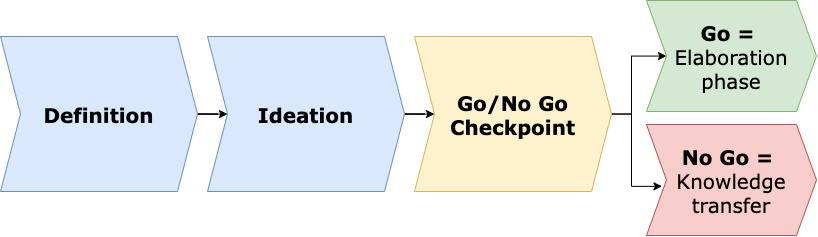
Defintion
We explore the problem/opportunity space and refine the project scope. As a UX Design Lead, I participated in desk research and competitive analysis and led a workshop with stakeholders and SMEs to define the problem to be solved, identify the target segment(s), and document assumptions.
Ideation
We converge to share potential solution ideas, diverge to refine and test concepts, and then converge again to share feedback with the team. During this phase, I designed an ideation workshop and led the team through a solution generation exercise based on the problem statements we created during definition. The team then evaluated the proposed ideas for assumed desirability, feasibility, and viability, voting on which concepts/features to prioritize in user testing. Based on votes, I designed sets of concept wireframes and/or interactive prototypes for user testing. As these were concept tests, my focus was more on functionality than on pixel-perfect UI. I explored different levels of fidelity in articulating these concepts to get the most informative feedback from testing possible. I supported the creation of research scripts and played a strong role in supporting insight analysis. We typically had 3-4 rounds of testing, between which I would iterate the design assets based on analysis of user feedback. After each round of testing, we shared high-level insights and design recommendations with the working team.
Go/No Go Checkpoint
Our definition and ideation phases led to a Go/No Go Checkpoint, where we presented our learning and recommendations to project sponsors. Sponsors would decide whether the team would continue, pivot, or stop the project. I worked closely with my UX and product co-leads to build a presentation for an executive leadership audience.
If the outcome of the checkpoint was “go” (i.e., we found that there is some value in our concept but need to answer more questions before starting work on an MVP), we would move into an elaboration phase, where we would continue to iterate our designs and value proposition as the business began to organize around the validated concept. During elaboration, we may be sharpening our leading concept or pivoting to take a slightly different direction based on user feedback.
If the decision was “no” (i.e., we could not find market fit, so we don’t recommend moving forward), we would document all of our learnings to ensure that if the idea was picked up again, a new team could hit the ground running.
Project Outcomes
Project One: No-go, but…
Our hypothesized solution failed due to a lack of market fit, but we learned a lot and saved the company from taking a big financial risk!
Our target opportunity area was too immature, and we were unable to identify enough consistency in user needs to launch an MVP without incurring massive risk. Despite this outcome, we were able to recommend moving forward with a strategic approach to advance existing capabilities that would prepare us for future success in the opportunity area.
Project Two: Go!
Our hypothesized solution was desirable, feasible, and viable - we could provide unique value to users while supporting our company’s objectives.
We proceeded into an elaboration phase to sharpen our MVP definition, ensuring that we could enter the market with a sticky solution that is both minimum-viable and minimum-loveable for our users. The next steps are to build up a cross-functional squad to build and ship the MVP based on the designs I created.